AI Translation Demo #2 - "Should the Apocrypha Be Bound with Bibles?"
As a second demonstration of an AI translation workflow, I present the project completed for the 1854 article “Sollen die Apokryphen des Alten Testaments ferner den Bibeln beigebunden werden oder nicht?” (“Should the Apocrypha of the Old Testament Continue to Be Bound with Bibles or Not?”), published in Der Lutheraner, Vol. 10, No. 11, St. Louis, January 17, 1854.
See also: Blog post introducing this project
The workflow follows the same pattern as the first AI translation demo, applied here to a previously untranslated Lutheran periodical article on a topic of continuing interest: the proper place of the Apocrypha in Lutheran theology and practice.
Step 1 — The Original Source Document
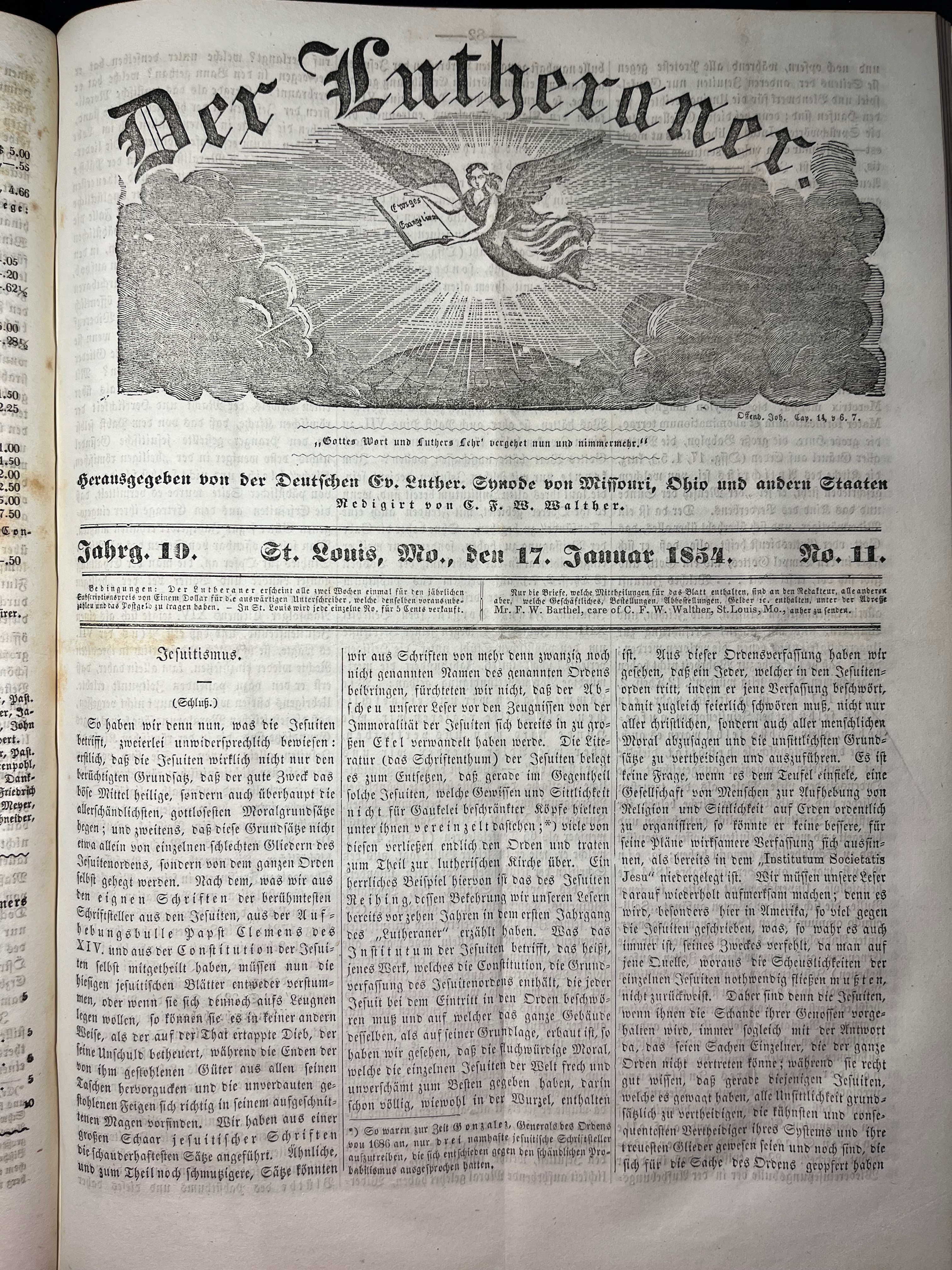
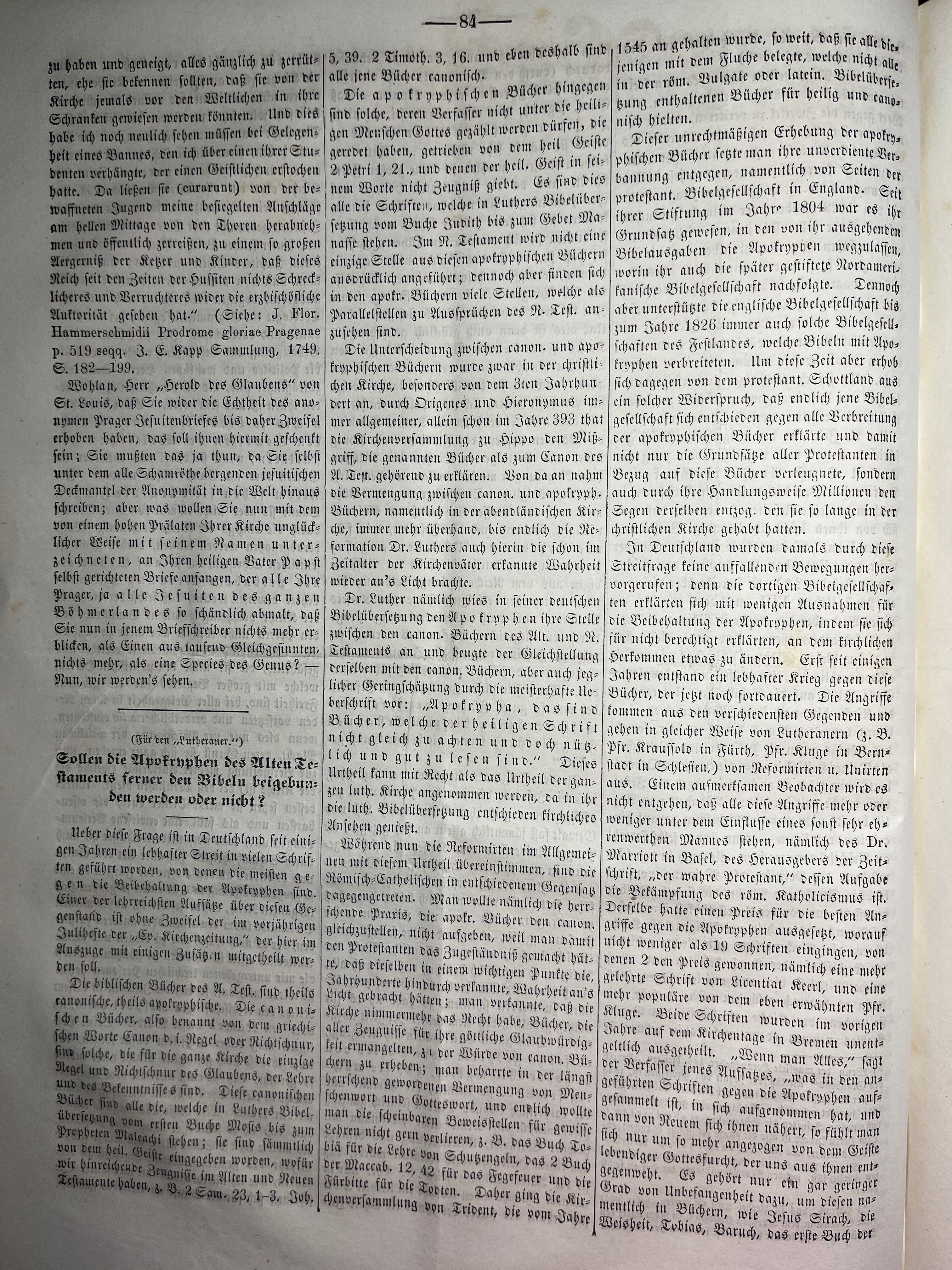
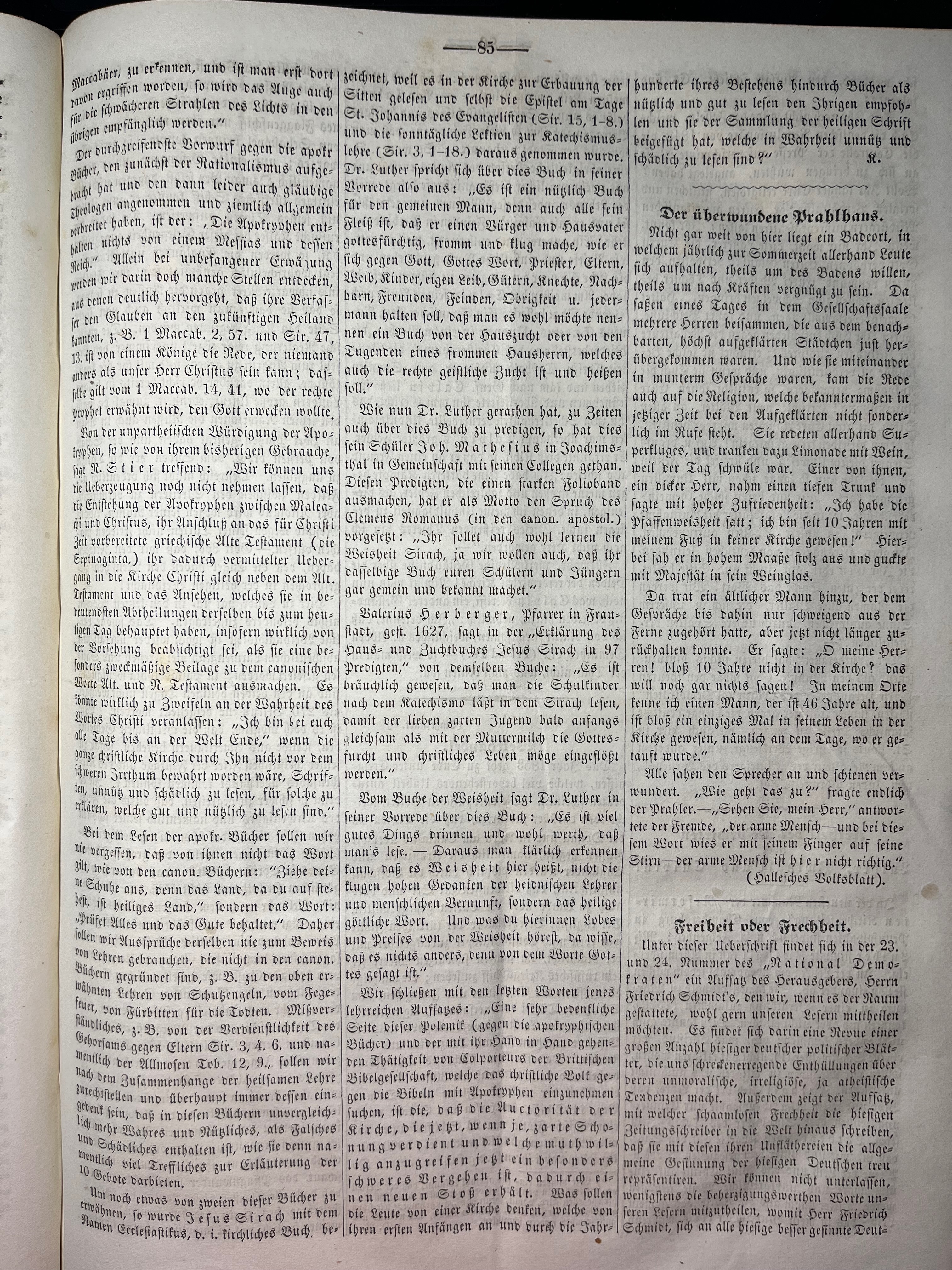
The source is a scanned image of the original printed article from Der Lutheraner, a Lutheran periodical founded by C.F.W. Walther and published in St. Louis. The article appeared in 1854 and presents a nuanced confessional Lutheran position on the Apocrypha — neither Rome’s over-elevation nor the British Bible societies’ total exclusion, but Luther’s own masterly middle way.
The original scans:
Step 2 — AI Extraction and Improvement of the German Text
Unlike the Von dem Namen Lutheraner project (which had a Google Books PDF with embedded OCR), this source was available as image scans only. The German text was extracted and corrected from the scans by Claude, producing a clean markdown file of the original German — including the period-typical orthography (e.g., Zeugniß, giebt, theils) and typographic conventions of 19th-century German Lutheran printing.
The corrected German source is available here: article-extracted-original-German.md — see the bilingual PDF below for the full German text alongside the translation.
Step 3 — Translation by Claude
Two AI models (Claude and Grok) independently produced full English translations. Both translations were compared and reviewed. The Claude translation was selected for this project as the final version, with particular attention to:
- Preserving the formal theological register of the original
- Rendering the Fraktur-era German idioms accurately (e.g., Regel und Richtschnur, Menschensatzungen, Hausvater)
- Maintaining the rhetorical structure of the longer quoted passages (Luther’s preface to Sirach, the N. S. quote on Providence, the closing polemic)
The full English translation (Claude, 2026) is presented in the bilingual documents below alongside the original German.
Result — Bilingual Editions
The final product is available in two formats: a print-quality PDF and an interactive HTML page. Both present the original German and the English translation in parallel, paragraph by paragraph.
PDF edition — scholarly bilingual layout with per-page Worterverzeichnis:
Apokryphen — Bilingual Edition (PDF), Nispel 2026
HTML edition — interactive web version with hover-tooltip glossary and dark mode:
Apokryphen — Bilingual Edition (HTML), Nispel 2026
A Note on Authorship
The article is signed only with the initial R. — a common convention in 19th-century German-American Lutheran periodicals. Some preliminary research into the author’s identity has been done as part of this project.
Speculative Identification of "R." — click to expand
Candidate: Pastor Carl Heinrich Rudolf Lange (1825–1892)
A plausible candidate is Carl Heinrich Rudolf Lange, an early Missouri Synod pastor and later professor at Concordia Seminary. The identification rests on circumstantial evidence; no primary source has been found that explicitly links the “R.” signature to Lange.
The article is not an original composition but an abridged reprint, with additions and editorial notes, of an essay that had appeared the prior year (1853) in the Evangelische Kirchenzeitung.
Circumstantial Evidence
The initial fits. Lange’s third given name was Rudolf, yielding the initial “R.”
Geographic proximity. In January 1854, Lange was pastor at Immanuel Lutheran Church in St. Charles, Missouri — immediately adjacent to St. Louis, where Der Lutheraner was published and edited by C. F. W. Walther.
Professional orbit. Lange was squarely within Walther’s circle. He later joined the Concordia Seminary faculty and co-edited Lehre und Wehre with Walther. A contributor relationship with Der Lutheraner in the 1850s is entirely plausible.
Scholarly profile. The article’s character — a curated excerpt from a German theological journal, prepared with editorial notes for an American Lutheran audience — fits the profile of a seminary-trained pastor with strong ties to the German theological press.
Assessment
The identification of “R.” as Carl Heinrich Rudolf Lange is plausible but unproven. The circumstantial case is reasonable — the initial, the geography, the professional network, and the intellectual profile all align. However, absent a primary-source confirmation (e.g., an index of Der Lutheraner contributors, an archival letter, or a contemporaneous attribution), this remains a speculative identification. Further research in the Concordia Historical Institute archives or digitized runs of early Der Lutheraner issues might resolve the question.
Sources
- Lutheran Heritage Foundation, “Happy 200th Birthday, Professor Lange” (January 8, 2025)
- LCMS Christian Cyclopedia, “Lange, Carl Heinrich Rudolf”
- Concordia Seminary Digital Library, Lehre und Wehre volumes
The initial AI-generated identification was produced by Grok (xAI); verification and assessment by Claude (Anthropic). April 2026.
Translations section: This translation is also listed on the Translations page under 19th Century American Lutheranism.